

There's a nervous excitement. Apparent is the chilled vapour exhaled by my competitors as they execute the "pre-race" wiggle on the starting line.
A rapid twitch of the hips.
I'm participating in my local weekly parkrun event and I mean business. The countdown begins...
Wait a second. I must sort my device. The same goes for the guy alongside me.
The person behind us tuts. I won't start until… done! Connection established, I'm off.
In the mele, it's difficult to see a wrist without a wearable on it. And this extends beyond us runners who wear them.
It's a explosive, massive industry. Companies like Apple Watch lead the market, each with an extensive selection of various devices to fit a range of budgets. Based on how advanced the device you select, costs can vary between an affordable sum to thousands of pounds.
"I find it infuriating, it's impossible to stop checking."
"It provides solace… It acts as a companion guiding me."
"Stop telling me about a restless night."
A handful of the reactions people have shared from like-minded device users when I ask what they their opinion is on theirs.
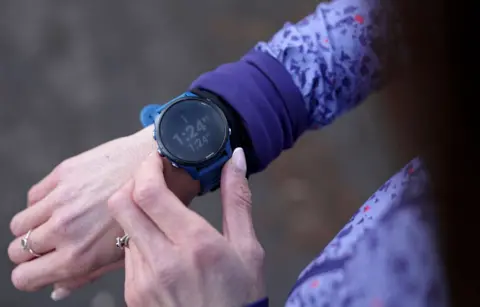
The Monitoring Conundrum
My current opinion on mine? Right now, frustrating. It's telling me I'm not hitting my target, making me wonder whether the foliage I'm passing under are blocking my location tracking.
A vast number of us fasten these small gadgets onto our arms and wear them constantly, ostensibly unconcerned with the fact they're constantly monitoring us.
A distant memory are the days when we depended on them solely to give us an rough count of our daily steps. Today, they can analyse our sleep patterns, blood pressure, oxygen saturation, our body battery.
It's tricky to find a physical metric they don't track.
But can they do what they advertise? And are the statistics we analyse a accurate representation of the truth? Do they boost our overall health, or do the avalanche of metrics and constant notifications just add to our sense of overwhelm?

Addiction or Aid?
"I become a quite obsessed with mine," an individual admits.
While she loves how her device monitors her workouts, she finds some of its other functions "excessive" at times - a feeling that became apparent during a major life event.
Prior to discovering she could adjust the settings, her smartwatch repeatedly informed her she was not being productive enough. Later on, the watch frequently reports her she's had a bad night's sleep.
"I've got a infant, there's no point to be notified my sleep was poor," she says. "I know that perfectly well."
Couldn't she just remove it?
"I could, I suppose, but I'm in this push-pull dynamic with it," she continues. "I appreciate it for its exercise data, but I'm unsure whether the additional features it can now do is possibly too much for me."
Inside the Device
Different brands of smartwatch has its own unique way of measuring your health metrics and processing your data, but the most use sensors on the underside of the watch.
They typically shine tiny, coloured LED lights onto your wrist which can monitor capillary action, recording your heartbeat. Higher-end devices measure changes in the skin conductance that runs through the skin to get an idea of your nervous system activity.
A Fine Balance
One expert says that for most people for smartwatches, it's a "delicate equilibrium" - while the ever-evolving tech could actually save lives, "identifying issues before we show symptoms", it could also turn us device users into the "concerned but fine".
He points out that the most advanced wearables can carry out tests like electrocardiograms (ECGs), which constantly monitor how normal the heart is. They can flag if someone is experiencing atrial fibrillation (AF), where there is abnormal signals in the heart causing an irregular heartbeat.
This does not mean someone is about to have a heart attack, but it can give an advance notice they might be more at risk of a blood clot in the long term.
But how to make sense of these figures is complex. The expert worries that as further capabilities are incorporated, people may struggle to fully understand their data.
"I remain sceptical that having the capacity to monitor so many things is such a beneficial thing," he says.
A clinical psychologist focusing on wearable tech concurs. Her work into the impact of wearable tech on a cohort of individuals with health issues suggested a noticeable percentage of those who were given devices to monitor their cardiac function experienced heightened worry and were "far more likely to use medical services".
She noted a cycle with her patients - they spotted a worrying figure on their watch. They grew concerned. Their heart rate increased. They got increasingly anxious. They looked a second time, and their heart rate rose further.
"When people are presented with stats about ourselves that we lack context for then, of course, we are going to become concerned," the psychologist says. "We check, we re-check - it becomes a feedback loop."
